Understanding A1C Levels Between 6.0 and 6.4: Your Guide to the Prediabetes Range
.jpg)
Natalie Stein
CDC Lifestyle Coach, Certified Diabetes Care and Education Specialist, and expert in nutrition, public health, and healthy lifestyle choices



In this article:
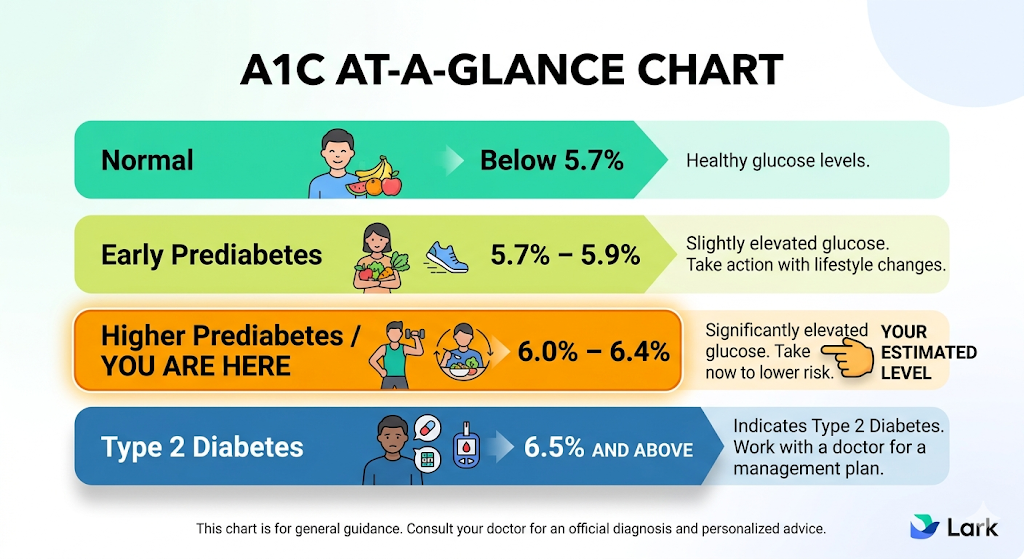
- An A1C between 6.0 and 6.4 indicates blood sugar that is in the upper part of the prediabetes range. It’s a risk factor for a diagnosis of diabetes.
- Additional health risks associated with blood sugar in this range include cardiovascular and small blood vessel concerns such as eye and kidney health.
- The Medicare Diabetes Prevention Program (MDPP) is a science-tested, year-long lifestyle change program that is designed to prevent or delay the onset of type 2 diabetes. It emphasizes small lifestyle changes like healthier eating and increasing physical activity.
- The MDPP is a covered benefit for some Medicare enrollees in Medicare B and Medicare Advantage. You can check today to see if you’re eligible.
- Lark has a fully online MDPP that members can access 24/7 for personalized coaching and tips to manage blood sugar and health. See if you qualify!
Your blood tests came back, and there’s a number that stands out: your A1C. Maybe it’s an A1C of 6.0, 6.2, or 6.4. If that’s the case, you may be wondering what it means - and what you can do about it.
Finding an A1C of 6.0 or higher and learning about prediabetes may feel scary, but there’s a lot of good news. First, when your A1C is 6.0 to 6.4, your level is in the prediabetes range, according to the American Diabetes Association. Knowing that you have prediabetes gives you a head start because most people with prediabetes don’t know they have it before it progresses to diabetes.
And that’s important - because there’s more good news. When you have prediabetes A1C levels, there’s a lot you can do about them. Your daily choices can affect blood sugar. Over time, the Centers for Disease Control and Prevention (CDC) explain that making healthy nutrition and physical activity choices can add up to prevent or delay the onset of type 2 diabetes.
More good news? There’s a program designed specifically for you - and it may be covered by your insurance! The Medicare Diabetes Prevention Program (MDPP) is a year-long program that emphasizes lifestyle changes to prevent or delay the onset of type 2 diabetes. Research shows that goals like losing extra weight and adding more physical activity can lower your risk for diabetes - and these effects appear even stronger in older adults!
Let’s take a look at A1C and what it can mean for daily life. Here’s your guide to the prediabetes range and what you can do about your blood glucose.
6.0 A1C: How It Relates to Blood Sugar
Your A1C is also called your glycated hemoglobin. It’s a measure of what percent of your hemoglobin has glucose molecules stuck to it. Let’s break that down!
- Hemoglobin is a protein in your blood.
- Glucose is the main type of sugar in your blood. It’s necessary to fuel cells in your body.
- Over time, extra glucose (or sugar) in your blood can attach or “stick” to hemoglobin. That’s called “glycated hemoglobin” or “A1C.”
- The more glucose that’s in your blood, the more glucose sticks to hemoglobin.
- The more glucose that sticks to hemoglobin, the higher your A1C is.
Your A1C value is a percent (%). An A1C of 6.0% means that 6.0% of your hemoglobin has glucose on it.
| Comparison | Fasting Plasma Glucose | A1c (Hemoglobin A1c) | ||||||
|---|---|---|---|---|---|---|---|---|
| What it Measures | Concentration of free-floating sugar in the blood at that exact moment. | Percentage of hemoglobin proteins that have glucose attached to them. | ||||||
| Timeframe | A "snapshot" of the present. | An average "movie" of the past 2–3 months. | ||||||
| Stability | Highly volatile; varies minute-to-minute based on current activity. | Very stable; reflects long-term metabolic trends. | ||||||
| Fasting Required? | Yes, strictly requires 8–12 hours without food/drink (except water). | No, fasting has no impact on the result. | ||||||
| Time of Day | Crucial; typically done in the morning for a true baseline. | Does not matter; can be tested at any time of day. |
| Category | Action Steps & Examples |
|---|---|
| Nutrition |
|
| Weight Management |
|


.webp)




.jpg)